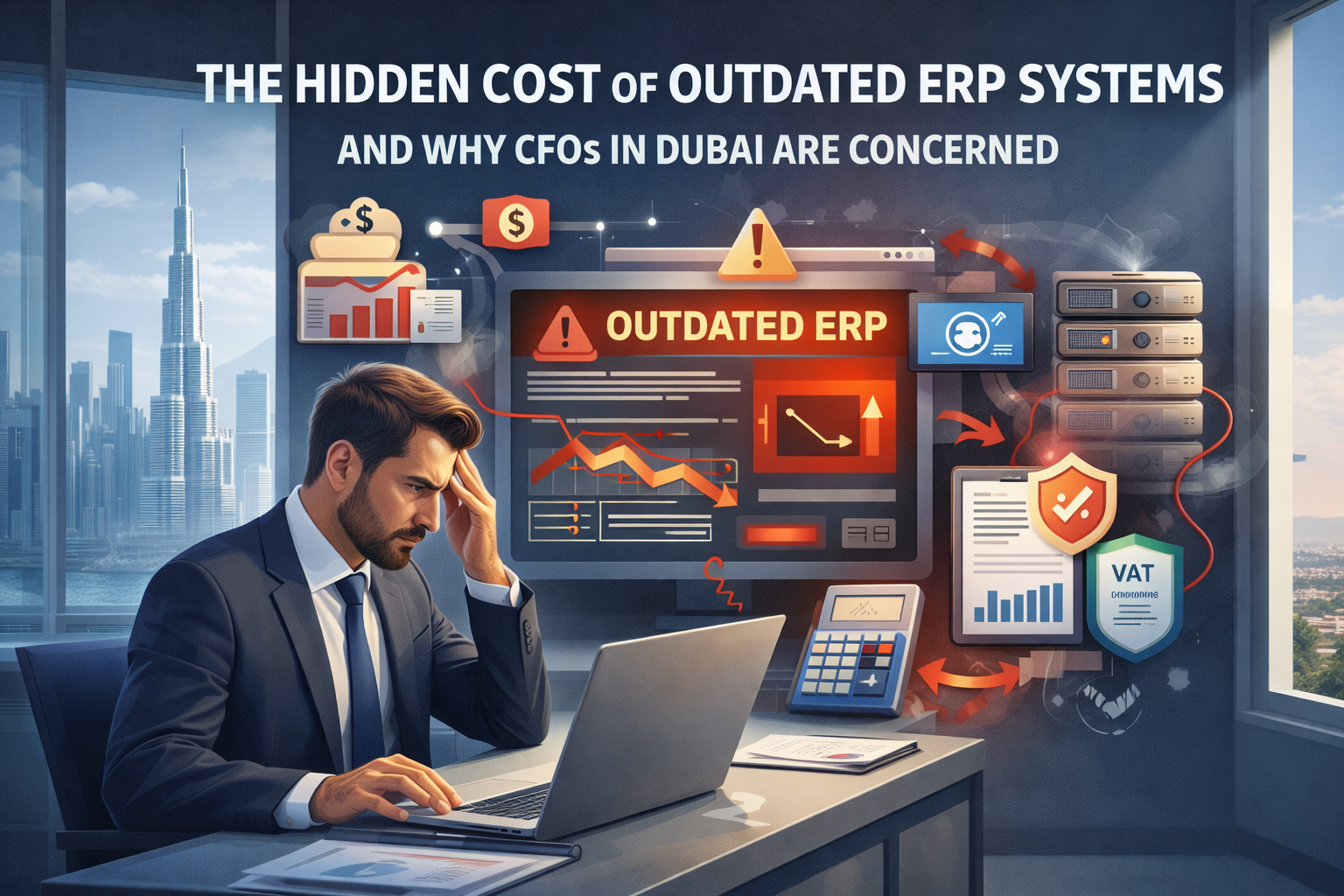
For many organisations, an ERP system once symbolised progress, a leap away from fragmented processes and manual reporting. But what happens when that system itself becomes outdated?
Across Dubai’s competitive business landscape, CFOs are confronting a reality that often remains invisible to operational teams: legacy ERP systems silently drain profitability, slow decision-making, and increase financial risk. The costs rarely appear as a single line item. Instead, they accumulate across inefficiencies, delays, errors, and missed opportunities.
Let’s uncover what those hidden costs truly look like.
1️⃣ The Illusion of “It Still Works”
An outdated ERP rarely collapses dramatically. It limps along.
Transactions process. Reports generate. Accounting closes, eventually.
This creates a dangerous illusion: If it’s functioning, why change it?
CFOs see beyond that illusion. They evaluate not just whether systems work, but how much value they fail to deliver.
Behind the scenes, outdated ERP systems often cause:
- Slower processing times
- Delayed financial reporting
- Manual data consolidation
- Workarounds using spreadsheets
- Limited system integrations
Each friction point translates into lost productivity and rising operational costs.
2️⃣ Productivity Loss That Doesn’t Show Up on Paper
One of the largest hidden expenses is employee time.
When systems lack automation or modern workflows, teams compensate manually:
- Finance staff reconcile data from multiple sources
- Sales teams re-enter customer information
- Inventory teams correct mismatches
- Managers wait days for reports
The payroll budget remains unchanged, but output per employee declines.
In high-cost markets like Dubai, where skilled talent commands premium salaries, inefficiency becomes extremely expensive. CFOs recognise that outdated ERP systems effectively convert highly paid professionals into data processors instead of strategic contributors.
3️⃣ Reporting Delays = Decision Delays
Speed matters in Dubai’s fast-moving economy.
Legacy ERP systems frequently struggle to provide:
- Real-time dashboards
- Instant financial visibility
- Accurate forecasting
- Dynamic analytics
As a result:
❌ Month-end closing stretches longer
❌ Budgeting cycles slow down
❌ Forecast accuracy drops
❌ Management decisions get delayed
When leadership operates on stale data, the financial consequences multiply, from misallocated budgets to missed growth opportunities.
Modern SaaS ERP platforms eliminate this lag by delivering live data access, automated reporting, and predictive insights.
4️⃣ Integration Failures Create Data Silos
Outdated ERP systems often lack compatibility with modern tools:
- CRM platforms
- E-commerce systems
- Payment gateways
- HR software
- BI dashboards
Businesses then rely on disconnected systems that don’t “talk” to each other.
The impact?
- Duplicate data entry
- Conflicting numbers
- Manual exports/imports
- Higher error rates
- Inconsistent customer experience
For CFOs, this fragmentation introduces data integrity risks and compliance concerns, especially critical under VAT regulations and financial reporting standards.
A modern ERP solution in Dubai must integrate seamlessly across the digital ecosystem.
5️⃣ The Escalating Cost of Maintenance
Many organizations underestimate how expensive legacy systems become over time.
Hidden maintenance costs include:
- Specialized IT support
- Custom patches and fixes
- Hardware upgrades
- Security vulnerabilities
- Downtime risks
Older ERP environments frequently require niche expertise that is scarce and costly. Meanwhile, cybersecurity threats evolve rapidly, exposing outdated systems to breaches that can result in financial penalties and reputational damage.
In contrast, SaaS ERP shifts the burden of updates, security, and infrastructure management to the provider.
6️⃣ Compliance & Audit Exposure
Dubai businesses operate within strict regulatory frameworks:
- VAT compliance
- Financial reporting standards
- Industry-specific regulations
Outdated ERP systems may lack:
- Automated tax calculations
- Audit trails
- Compliance updates
- Accurate reporting modules
Manual adjustments increase the probability of:
⚠️ Filing errors
⚠️ Audit flags
⚠️ Financial penalties
⚠️ Reputational damage
CFOs understand that compliance failures cost far more than system upgrades.
7️⃣ Growth Constraints: The Silent Business Killer
Perhaps the most dangerous cost is lost scalability.
Legacy ERP systems often struggle with:
- Expanding transaction volumes
- Multi-entity operations
- Multi-currency management
- Advanced analytics
- Automation capabilities
As companies grow, the system becomes a bottleneck instead of a growth enabler.
Dubai enterprises pursuing expansion, diversification, or digital transformation increasingly adopt SaaS ERP because it scales without disruptive reinvestment.
Why CFOs in Dubai Are Prioritizing SaaS ERP
Finance leaders focus relentlessly on:
✅ Cost efficiency
✅ Risk reduction
✅ Cash flow visibility
✅ Forecast accuracy
✅ Strategic agility
Modern SaaS ERP solutions deliver precisely these outcomes:
- Real-time financial dashboards
- Automated workflows
- Lower infrastructure costs
- Continuous updates
- Enhanced data security
Instead of reacting to problems, CFOs gain the tools to anticipate, analyse, and act.
Choosing the Right ERP Partner Matters
Technology selection is only half the equation. Implementation and ongoing optimisation define success.
When evaluating the best ERP solutions provider in Dubai, organisations should look for:
✔ Local compliance expertise
✔ Industry-specific knowledge
✔ Customizable solutions
✔ Strong migration strategy
✔ Reliable post-implementation support
A capable ERP partner ensures a smooth transition, strong adoption, and measurable ROI.
Final Thought: The Cost of Inaction Is Rising
Outdated ERP systems rarely trigger urgency — until inefficiencies become crises.
By then, businesses face:
- Operational disruptions
- Compliance risks
- Competitive disadvantages
- Escalating costs
Forward-thinking CFOs refuse to wait for that tipping point.
They recognise that investing in a modern ERP solution in Dubai, particularly a scalable SaaS ERP, is not an IT decision; it’s a financial strategy.
Ready to Eliminate Hidden ERP Costs?
If your ERP system feels slow, rigid, or heavily dependent on manual processes, the warning signs are already visible.
Upgrade to a modern SaaS ERP built for Dubai’s dynamic business environment.
Gain clarity. Improve efficiency. Unlock growth.