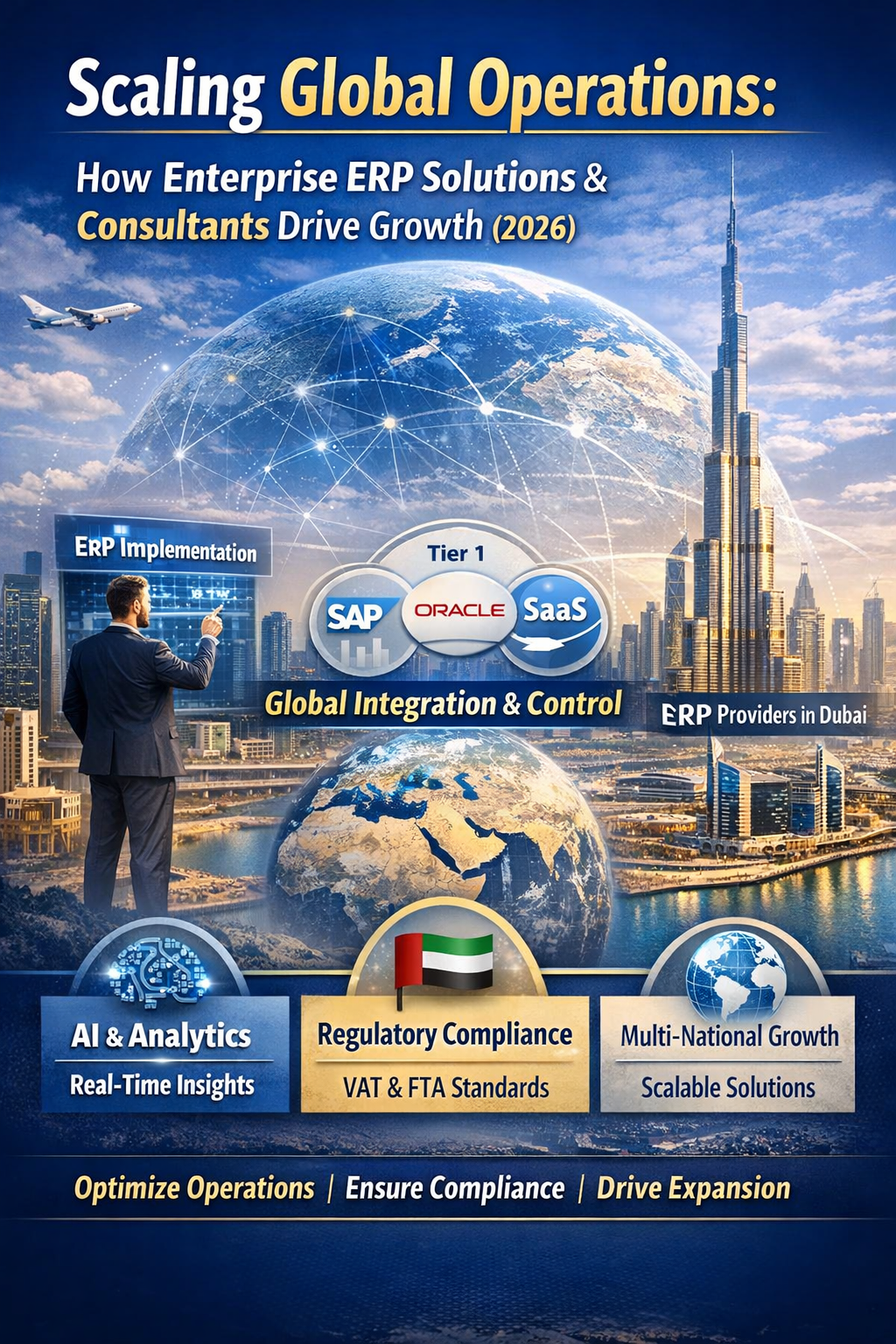
In the world of billion-dollar corporations, “growth” often brings “chaos.” As a business expands across borders, from New York to London to Dubai, it faces a fragmented mess of data, disconnected departments, and conflicting regulations. This is where enterprise ERP solutions become non-negotiable. For an individual or a company or an organisation in the high-tech trade hubs of the UAE or the manufacturing belts of Europe, the challenge is the same: How do you keep a thousand moving parts in sync? This guide explores the strategic partnership between large businesses, ERP solution consultants, and the technology that makes 10x growth possible.
Here’s what we’ll cover:
- Why “Enterprise” ERP is different from standard business software.
- How a consultant saves you millions in implementation errors.
- Why has Dubai become a global testbed for the best ERP software solution provider models?
Key Terms & Definitions
- Enterprise ERP: High-tier software (like SAP S/4HANA or Oracle Fusion) designed for massive data volumes and complex global hierarchies.
- ERP Solution Consultant: A strategic advisor who maps your business’s “human” processes to the software’s “technical” capabilities.
- SaaS (Software as a Service): Cloud-based ERP that you subscribe to, rather than owning on physical servers.
- Tier 1 Vendors: The global leaders in the ERP market capable of supporting multi-national, multi-currency operations.
What are Enterprise ERP Solutions?
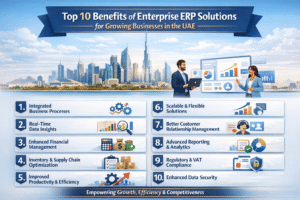
Enterprise ERP solutions in UAE are integrated software platforms used by large organisations to manage and automate nearly every core business function. Unlike basic ERPs used by small businesses, enterprise-grade systems are built to handle thousands of concurrent users, manage multi-country tax compliance, and provide real-time analytics across global supply chains. It is the “Single Source of Truth” that prevents a CEO in Dubai from seeing different financial numbers than a CFO in Singapore.
The Role of an ERP Solution Consultant
Implementing an enterprise system is like performing an organ transplant on a marathon runner while they are still running. You don’t do it alone.
An ERP solution consultant performs three vital roles:
- The Architect: They gather requirements from every department to ensure the software actually fits your workflow.
- The Risk Manager: 70% of ERP projects fail due to poor planning. Consultants identify “red flags” before they become costly disasters.
- The Trainer: They manage “Change Management,” ensuring your 5,000 employees actually know how (and why) to use the new system.
The Benefits and Challenges of Enterprise ERP
| Advantages (Scaling Factors) | Implementation Challenges |
| Global Consolidation: View all international subsidiaries in one dashboard. | Data Silos: Merging “messy” data from 20 different old systems is difficult. |
| AI-Powered Insights: Predict market shifts and inventory needs 6 months out. | High Initial Investment: Tier 1 solutions require significant capital or high monthly OpEx. |
| Regulatory Compliance: Auto-updates for UAE VAT, EU GDPR, and US Tax codes. | Resistance to Change: Large workforces often struggle with new digital workflows. |
Understanding Regional Variations: The Dubai Context
In 2026, Dubai is no longer just a regional player; it is a global digital leader. Large businesses looking for ERP solution providers in Dubai face unique local factors:
- The “Economic Vision 2033” Impact: Government mandates for paperless trade mean your ERP must integrate with national digital platforms.
- Free Zone Complexity: Companies operating in JAFZA or DAFZA need specific reporting modules that generic software might lack.
- Multi-National Talent: Dubai-based systems must support dozens of languages and diverse payroll structures (including the Wage Protection System – WPS).
Industry Quote: “The best ERP software solution provider in Dubai isn’t just selling code; they are selling the ability to navigate the UAE’s rapid regulatory shifts without stopping your business.” — Senior Supply Chain Analyst.
Future Trends: What’s Next for Enterprise ERP?
- AI-Native ERP: By the end of 2026, ERPs won’t just record data; they will act as “Agentic Workers,” automatically flagging fraud or suggesting better shipping routes.
- Composable ERP: Instead of one giant “monolithic” software, businesses are moving toward a “plug-and-play” model where you pick the best-of-breed modules for HR, Finance, and Logistics.
- Sustainability (ESG) Tracking: International investors now demand environmental data. Modern ERPs now have built-in “Carbon Calculators” for every product sold.
Vendor Selection Tips for Global Scale
- Check the “Dubai Footprint”: Does the vendor have a local office and a track record with UAE government compliance?
- Evaluate AI Readiness: Is the AI built-in (Native), or is it just a “bolt-on” that will cost extra later?
- Ask for Industry Specifics: A manufacturing ERP is not the same as a retail ERP. Demand a demo that uses your data.
- Security & Sovereignty: In 2026, data residency matters. Ensure your enterprise ERP solutions can store data within the UAE if required by law.
Key Takeaways for International Readers
| Aspect | Universal Truth | What to Check Locally |
| Consultancy | A consultant is cheaper than a failed project. | Check their experience with local tax/labor laws. |
| Technology | Cloud is the standard for 2026. | Internet stability and local data center options. |
| Compliance | Global systems must handle “Multi-Tax.” | Ensure specific “FTA-Approved” VAT modules. |
| Scalability | Tier 1 ERPs are built for “unlimited” growth. | Check per-user licensing costs in your region. |
Frequently Asked Questions
1. Why do large businesses need an ERP consultant?
Large businesses have too many moving parts for an “out-of-the-box” setup. A consultant ensures the software aligns with complex corporate hierarchies and global tax laws.
2. How does ERP help in scaling faster?
By automating manual tasks (like invoicing and payroll) and providing real-time data, leadership can make faster decisions without waiting for weekly reports.
3. Are there specific ERP solution providers in Dubai for large-scale?
Yes, Dubai has a mature ecosystem of Tier 1 partners who specialise in the Middle East’s unique trade and compliance requirements.
4. What is the cost of an enterprise ERP implementation?
For large businesses, costs often range from $100k to several million, depending on the number of users, locations, and customisation needed.
Conclusion
Scalability is the ultimate test of an organisation’s foundation. While the software provides the structure, it is the strategic insight of an ERP solution consultant that ensures that structure doesn’t crumble under the weight of growth. As we move through 2026, the businesses that win will be those that view their ERP not as an “IT expense,” but as a strategic engine for global dominance.
The crucial next step is to research the specific guidelines, regulations, and certified experts in your local area. When you are ready to make the move, remember that Enhance ERP offers the best Enterprise ERP Solutions in Dubai, combining global expertise with deep local knowledge to help your business scale faster.