Growth is exciting. It also exposes cracks in your operations.
What worked with spreadsheets, standalone accounting tools, and disconnected software quickly becomes inefficient, error-prone, and difficult to scale. This is exactly where an enterprise resource planning ERP system becomes a strategic necessity.
If you’re evaluating enterprise ERP solutions or researching ERP enterprise software, this guide clarifies what an ERP system really is, why it matters, and how growing businesses benefit from adopting one.
Understanding Enterprise Resource Planning (ERP)
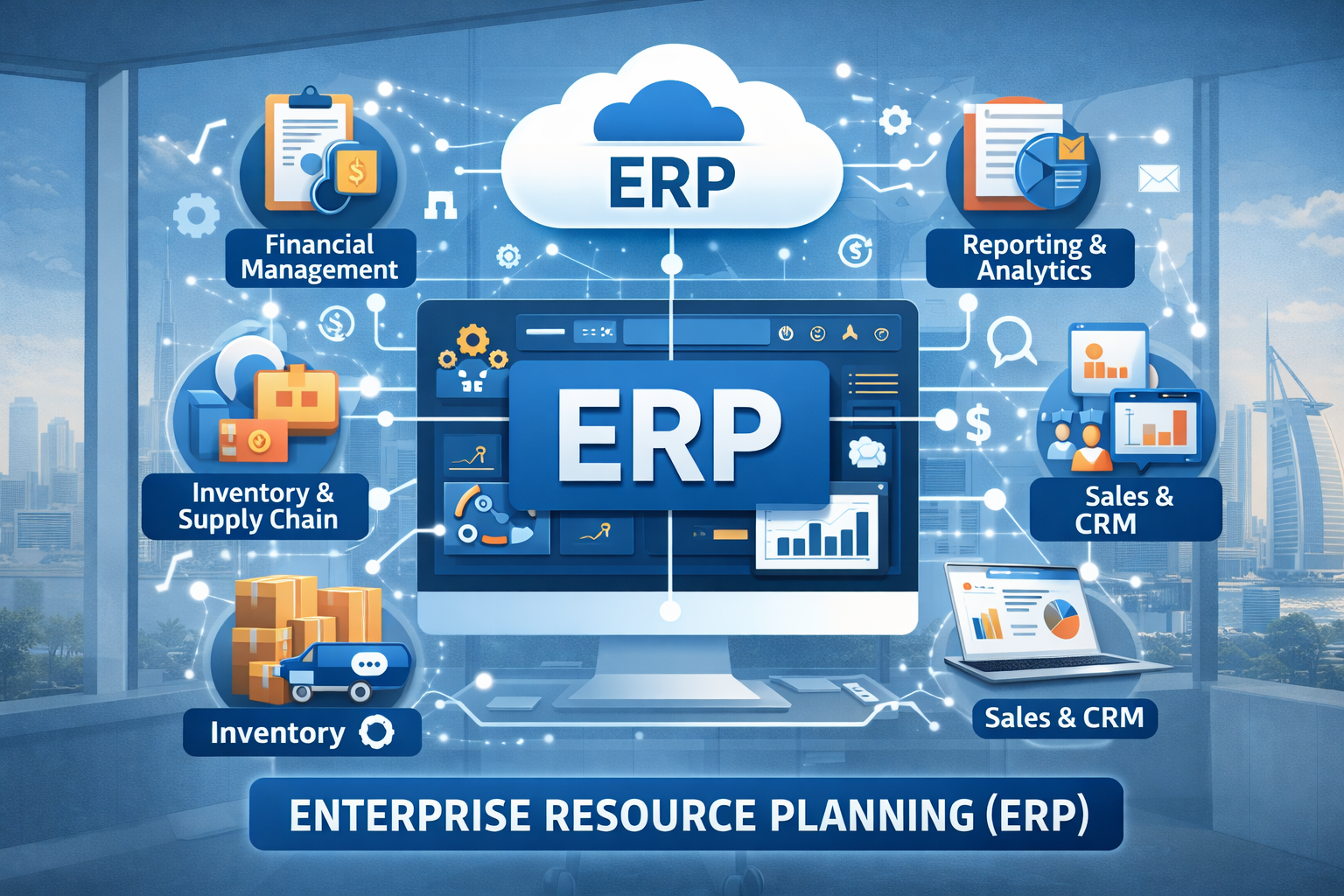
At its core, enterprise resource planning ERP refers to a centralised software platform that integrates and manages key business processes across departments.
Instead of operating with separate systems for:
- Finance
- HR
- Inventory
- Procurement
- Sales
- Operations
An enterprise resource planning ERP system connects everything within a single environment.
The result:
✅ Unified data
✅ Streamlined workflows
✅ Real-time visibility
✅ Better decision-making
What Exactly Does an ERP System Do?
An enterprise resource planning ERP system acts as the digital backbone of your organisation. It standardises, automates, and synchronises processes such as:
📊 Financial Management
- General ledger
- Accounts payable/receivable
- Budgeting & forecasting
- Tax & compliance
📦 Inventory & Supply Chain
- Stock tracking
- Procurement workflows
- Vendor management
- Demand planning
👥 Human Resources
- Payroll
- Attendance
- Recruitment
- Performance tracking
🤝 Sales & Customer Management
- CRM integration
- Order processing
- Billing & invoicing
📈 Reporting & Analytics
- Dashboards
- KPIs
- Real-time insights
Instead of manually consolidating reports from multiple systems, ERP enterprise software delivers a single source of truth.
Why Growing Businesses Outgrow Traditional Software
Early-stage businesses often rely on:
- Excel spreadsheets
- Basic accounting tools
- Standalone inventory systems
- Separate HR/payroll apps
Initially, this feels cost-effective.
But as operations expand:
❌ Data duplication increases
❌ Errors multiply
❌ Reporting slows down
❌ Teams lose alignment
❌ Visibility disappears
Growth amplifies inefficiency.
An enterprise ERP system eliminates these issues by connecting processes instead of patching them.
Key Benefits of Enterprise ERP Systems
1️⃣ Centralised Data & Accuracy
With enterprise ERP systems, all departments operate on the same dataset.
No more:
- Conflicting numbers
- Version-control nightmares
- Manual reconciliations
Accuracy improves dramatically.
2️⃣ Operational Efficiency
Automation replaces repetitive manual tasks:
- Invoice generation
- Purchase approvals
- Inventory updates
- Payroll calculations
Your workforce shifts from data entry → value creation.
3️⃣ Real-Time Decision Making
Modern ERP enterprise software provides live dashboards showing:
- Cash flow
- Revenue trends
- Cost structures
- Inventory levels
Leadership acts instantly, not retrospectively.
4️⃣ Scalability Without Disruption
An enterprise resource planning ERP system grows with your business:
- New users
- New locations
- Higher transaction volumes
- Additional modules
No need to rebuild your tech stack.
5️⃣ Compliance & Risk Control
ERP platforms strengthen:
- Audit trails
- Financial controls
- Tax calculations
- Regulatory reporting
Risk exposure decreases.
Cloud ERP vs Traditional ERP
Today’s enterprise ERP solutions increasingly operate in the cloud.
☁️ Cloud / SaaS ERP Advantages:
✅ Lower upfront investment
✅ Faster implementation
✅ Automatic updates
✅ Anywhere access
✅ Enhanced security
Traditional on-premise systems demand heavy infrastructure, maintenance, and upgrade costs.
For growing businesses, cloud-based ERP enterprise software delivers agility without technical complexity.
When Should a Business Implement an ERP System?
Consider an enterprise ERP system if you’re experiencing:
- Rapid growth
- Multi-department complexity
- Reporting delays
- Inventory inaccuracies
- Cash flow visibility challenges
- Heavy spreadsheet dependency
ERP is not just for large corporations anymore. Mid-sized and scaling businesses gain enormous value from early adoption.
Choosing the Right Enterprise ERP Solutions
Not all ERP systems — or providers — are equal.
When evaluating enterprise ERP solutions, prioritize:
✔ Business-specific functionality
✔ Ease of use
✔ Scalability
✔ Integration capabilities
✔ Industry relevance
✔ Local compliance support
Most importantly, select a trusted implementation partner.
Why the ERP Provider Matters
Even the best ERP enterprise software fails without proper configuration and deployment.
A strong ERP partner ensures:
✅ Smooth data migration
✅ Customization aligned with workflows
✅ Minimal operational disruption
✅ User training & adoption
✅ Ongoing optimization
The right provider transforms ERP from a software purchase → a business transformation.
The Strategic Impact of ERP Enterprise Software
Businesses implementing enterprise ERP systems consistently report:
📈 Higher efficiency
📊 Better visibility
💰 Improved cost control
⚡ Faster reporting
🚀 Stronger scalability
ERP is no longer an IT upgrade.
It is a growth, profitability, and control strategy.
Final Thoughts
Growth should not create chaos.
An enterprise resource planning ERP system provides the structure, automation, and intelligence needed to scale confidently. It unifies your data, aligns your teams, and equips leadership with real-time insights.
For growing businesses, investing in modern enterprise ERP solutions is not optional — it’s a competitive advantage.
Ready to Modernize Your Operations?
If disconnected systems, manual processes, and reporting delays are slowing your momentum, it’s time to explore a powerful ERP enterprise platform.
Upgrade your systems.
Empower your teams.
Scale without limits.